Biopolymer Gel from Pineapple Peel (Ananas comosus) Waste-Based Gel with Sodium Chloride (NaCl) for Optimizing Electrocardiogram (ECG) Signal Recording
DOI:
https://doi.org/10.23960/jemit.386Keywords:
ECG Gel, Pineapple Peel Waste, Conduvtivity, ECG Signal, NaClAbstract
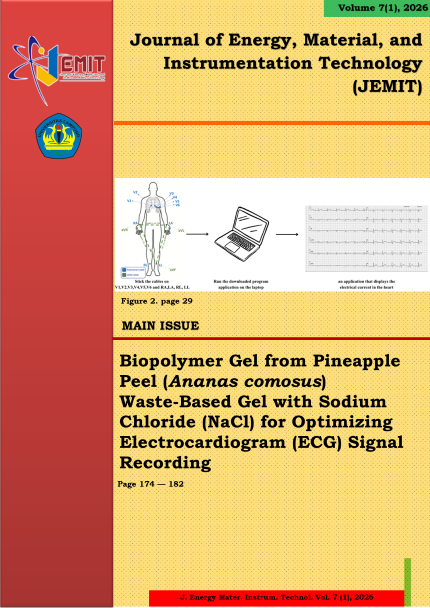
Pineapple peel (Ananas comosus) as organic waste has potential as a raw material for biomedical gel in electrocardiogram (ECG) recording. ECG gel functions as a conductive medium facilitating electrical transmission between skin and electrodes to improve cardiac signal accuracy. This study developed gel from pineapple peel waste with sodium chloride (NaCl) addition for ECG recording optimization. The process included pineapple peel extraction, gel formulation using carbomer 940, and extract concentration variations of 10-100%. Evaluation was conducted on physical properties including electrical conductivity, viscosity, pH, density, crust thickness, and ECG recording performance. Results showed gel with 20-50% pineapple peel extract had high conductivity, skin-compatible pH (4.5-7), and reduced crust thickness. ECG recording produced well-defined P, QRS, and T waves with minimal noise. These findings demonstrate that pineapple peel waste-based gel is a promising eco-friendly alternative for cardiac diagnostics and sustainable organic waste utilization.
Downloads
References
Lubis, A.W., Maulina, J. (2020). Pemanfaatan ekstrak kulit nanas (Ananas comosus L.) dalam pembuatan hand wash sebagai antibakteri. Biology Education Science and Technology, 3(1), 70–75.
Anggraini, D. A., Shidiq, A. A. A., Siregar, P., Avriya, V., Nurhaliza, D., & Rati, T. A. (2022). Pemanfaatan limbah kulit nanas sebagai bahan pembuatan paper soap untuk meningkatkan perekonomian masyarakat Desa Kualu Nenas. Jurnal Pengabdian Untukmu Negeri, 6(2), 117–122.
Attia, Z. I., Noseworthy, P. A., Lopez-Jimenez, F., Asirvatham, S. J., Deshmukh, A. J., Gersh, B. J., Carter, R. E., Yao, X., Rabinstein, A. A., Erickson, B. J., Kapa, S., & Friedman, P. A. (2019). An artificial intelligence–enabled ECG algorithm for the identification of patients with atrial fibrillation during sinus rhythm: A retrospective analysis of outcome prediction. The Lancet, 394(10201), 861–867. https://doi.org/10.1016/S0140-6736(19)31721-0
Basuki, I. Y. S. F. (2014). Efektivitas hasil perekaman EKG dengan menggunakan konduktor jeli dan air pada pasien penyakit jantung koroner (PJK) di ruang intensive cardio vascular care unit (ICVCU) RSUD Dr. Moewardi. Jurnal Ilmu Keperawatan Indonesia, 7.
Carvalho, R. O., Figueiredo, R. M. F., Queiroz, A. J. M., Santos, F. S., Gregorio, M. G., Amadeu, L. T. S., Moura, H. V., Almeida Junior, N. M., Andrade, F. S., Cruz, E. B. C., Lara, E. Z., Gomes, J. P., & Madruga, M. S. (2025). Dynamic modeling of convective drying of pineapple peels: Bioactive, physical, and thermal properties. Agriculture, 15(6). https://doi.org/10.3390/agriculture15060609
Chen, L. Y., Ribeiro, A. L. P., Platonov, P. G., Cygankiewicz, I., Soliman, E. Z., Gorenek, B., Ikeda, T., Vassilikos, V. P., Steinberg, J. S., Varma, N., Bayes de Luna, A., & Baranchuk, A. (2022). P wave parameters and indices: A critical appraisal of clinical utility, challenges, and future research. Circulation: Arrhythmia and Electrophysiology, 15(4), e010435. https://doi.org/10.1161/CIRCEP.121.010435
Das, G., Patra, J. K., Debnath, T., Ansari, A., & Shin, H. S. (2019). Investigation of antioxidant, antibacterial, antidiabetic, and cytotoxicity potential of silver nanoparticles synthesized using the outer peel extract of Ananas comosus (L.). PLOS ONE, 14(8). https://doi.org/10.1371/journal.pone.0220950
Fan, C., Xu, K., Huang, Y., Liu, S., Wang, T., Wang, W., Hu, W., Liu, L., Xing, M., & Yang, S. (2021). Viscosity and degradation controlled injectable hydrogel for esophageal endoscopic submucosal dissection. Bioactive Materials, 6(4), 1150–1162. https://doi.org/10.1016/j.bioactmat.2020.09.028
Febriningrum, P. N. (2013). Pengaruh konsentrasi substrat kulit nanas dan kecepatan pengadukan terhadap pertumbuhan Lactobacillus plantarum untuk produksi asam laktat. Jurnal Rekayasa Kimia dan Lingkungan, 9(3), 144–151. https://doi.org/10.23955/rkl.v9i3.784
Fitrya, N., Halwani, P., & Putra Wirman, S. (2022). Uji karakteristik elektrolit ampas kulit nanas dengan penambahan MgCl2, NaCl, dan KCl. Jurnal Sains dan Kesehatan, 13(2), 35–40. https://doi.org/10.37859/jp.v13i2.4394
Garza, S., & Ibarz, A. (2010). Effect of temperature and concentration on the density of clarified pineapple juice. International Journal of Food Properties, 13(4), 913–920. https://doi.org/10.1080/10942910902919596
Gavahian, M. (2023). Valorized pineapple waste by conventional and energy-saving ohmic extraction: Potentially toxic elements and mycotoxin contamination. Quality Assurance and Safety of Crops and Foods, 15(4), 11–21. https://doi.org/10.15586/qas.v15i4.1361
Goncalves, M. A. A., Pedro, J. M., Silva, C., Magalhaes, P., & Brito, M. (2020). Normal limits of the electrocardiogram in Angolans. Journal of Electrocardiology, 63, 68–74. https://doi.org/10.1016/j.jelectrocard.2020.10.011
Grigatti, A., & Gefen, A. (2022). What makes a hydrogel-based dressing advantageous for the prevention of medical device-related pressure ulcers. International Wound Journal, 19(3), 515–530. https://doi.org/10.1111/iwj.13650
Hnatkova, K., Andrsova, I., Toman, O., Smetana, P., Huster, K. M., Sisakova, M., Barthel, P., Novotny, T., Schmidt, G., & Malik, M. (2021). Spatial distribution of physiologic 12-lead QRS complex. Scientific Reports, 11(1). https://doi.org/10.1038/s41598-021-83378-8
Irani, B. P., Purnamasari, I., Pratama, N., Istiqlawati, S. D., & Putri, T. D. (2018). Fermentation of waste pineapple peel as electricity source. SSRN Electronic Journal. https://doi.org/10.2139/ssrn.3192587
Kashani, A., & Barold, S. S. (2005). Significance of QRS complex duration in patients with heart failure. Journal of the American College of Cardiology, 46(12), 2183–2192. https://doi.org/10.1016/j.jacc.2005.01.071
Lee, Y., Yim, S. G., Lee, G. W., Kim, S., Kim, H. S., Hwang, D. Y., An, B. S., Lee, J. H., Seo, S., & Yang, S. Y. (2020). Self-adherent biodegradable gelatin-based hydrogel electrodes for electrocardiography monitoring. Sensors, 20(20). https://doi.org/10.3390/s20205737
Sari, A. P. Y., Hening, P. T. C., Nikita, M., Al Fatah, A. M., Riyadi, F. R., & Rahayu, I. D. (2024). Formulation and characteristics of hydrogel patch containing pineapple peel (Ananas comosus L.) ethanol extract. Media Farmasi Indonesia, 19(2), 156–165. https://doi.org/10.53359/mfi.v19i2.296
Downloads
Published
How to Cite
Issue
Section
License
Copyright (c) 2026

This work is licensed under a Creative Commons Attribution 4.0 International License.